Analyzing Current and Future Workforce Issues: Student Perspectives on Career Development - Vol 1 & Vol 2
"Born out of a graduate course at the University of Minnesota, [this] publication is more than just a collection of student projects. It is proof that when graduates students are challenged to think critically, to write for a professional audience, and to contribute as peers, they rise to the occasion. Their chapters explore pressing issues, from diversity and equity in the workplace to alternative career pathways, and apply theory to practice with fresh eyes and bold ideas." (2025, p. v)
 |
|
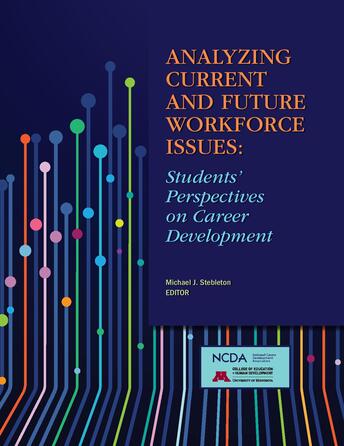
| Download now: Analyzing current and future workforce issues: Student perspectives on career development (Vol. 1, 2025) |
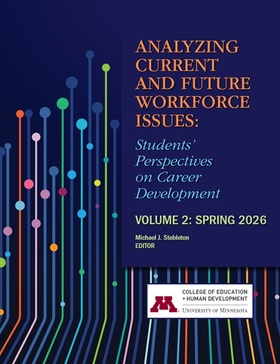
Download now: Analyzing Current and Future Workplace Issues: Students Perspectives on Career Development (Vol. 2, 2026)
|
| Stebleton, M. J. (ed.). (2025). Analyzing current and future workforce issues: Student perspectives on career development. National Career Development Association. |
Stebleton, M. J. (ed.). (2026). Analyzing current and future workforce issues: Student perspectives on career development, Vol. 2: Spring 2026. University of Minnesota. |
TABLE OF CONTENTS
FOREWORD
Marty Apodaca
INTRODUCTION
Michael J. Stebleton
Instructions to Students
EXPLORING CURRENT ISSUES IN CAREER DEVELOPMENT
Employee Retention and Generational Issues – Ani Grothe
The Future is Hybrid – Jasmine White
DEI and Organizational Diversity Issues and Trends: Applications in Career Development – Rachel Blankenship
Organizational Leadership Development Programs and Employee Career Development – Nick Hartman
AI: A Possible Career Development Tool and Not Our Replacement – Nathan Price
Done with the Hustle: Time to Rethink 996 – Guoying Li
Women in the Workplace: Career Development and the Motherhood Penalty – Yuxin Xue
APPLYING CAREER DEVELOPMENT MODELS TO
SUPPORT SPECIFIC POPULATIONS
Supporting the Career Development of LGBTQ+ Workers – Shannon McCrady
The Role and Importance of Career Messaging and Development Support for Black, Indigenous Students of Color – Leslie Garcia
Addressing Male College Enrollment Decline Using Career Development Theories – Kirsten Koerth
Reimagining Career Development for First-Generation Students: An Indigenous-Informed Approach – Trinity Vang
Employee Mental Health: An Examination of Organizational Culture and Leadership Approaches – Yenming Peng
The Role of Schools in Shaping Future Careers – Sally Spreeman
Applying Chaos Theory to Non-College-Educated African Americans – Christian Martin
|
TABLE OF CONTENTS
PREFACE
Michael J. Stebleton
Instructions to Students
EXPLORING CURRENT ISSUES IN CAREER DEVELOPMENT
Microcredentials and Workforce Readiness: Bridging the Skills Gap – Danielle Rintala
Return to Office Mandates: How They Harm Women in the Workforce – Julie Olson Rand
Alone on the Ladder: Remote Work as an Early-Career Professional – Brian Wray
Second Hand Student Mental Health Cases: Influences on Student Affairs Staff
– William Ver Mulm
Enhancing Employee Engagement in the Workplaces – Emery Rwandanga
Gen Z Transitioning from College to the Workplace – Allison Maus
The Entry-Level Crisis: Why Organizations Must Reinvest in Early-Career Talent
– Alivia Perna
College Graduates’ Job Tenure from a Skills Mismatch Perspective
– Yerbol Moldakassimov
APPLYING CAREER DEVELOPMENT MODELS TO
SUPPORT SPECIFIC POPULATIONS
Supporting PhD Graduates Not Entering Tenure-Track Careers – Luke Feuling Porter
What Can I Be When Grow Up: Supporting Neurodiverse High School Students in Career
Exploration and Counseling – Sammy Loeks-Davis
Examining the Career Development of International First-Generation College Students
Shadrack Kipsang
The Impact of Systemic Barriers on Black Women Achieving Teacher Licensure
– Zoe Ann Boynton
Chaos In and Out of the Closet: Queer Identity in the Workplace –Matt Loosbrock
Career Development in Recovery: Supporting Career Pathways for Individuals with
Substance Use Histories – William Patten
Returning to Work After Military Training or Deployment: Challenges, Reintegration, and
Organizational Support – Michelle McIntosh
Non-Apparent Disabilities in the Workplace: An Analysis of Disclosure Gaps in the White-
Collar Workforce – Maddigan DeBoth
|
|
EDITOR
Michael J. Stebleton, PhD, is a Professor of Higher Education at University of Minnesota-Twin Cities. He teaches both undergraduates and graduate students in the Department of Organizational, Leadership, Policy, and Development. Contact Dr. Stebleton at: steb0004@umn.edu
|
EDITOR
Michael J. Stebleton, PhD, is a Professor of Higher Education at University of Minnesota-Twin Cities. He teaches both undergraduates and graduate students in the Department of Organizational, Leadership, Policy, and Development. Contact Dr. Stebleton at: steb0004@umn.edu
|
| Acknowledgements: Melissa Venable, Melanie Reinersman, and former NCDA President Marty Apodaca for their ongoing support of this project |
Acknowledgements: Alex Evenson for assistance with design and organization. |
For more information, see the article in Career Convergence:
Engaging Future Career Educators Through Writing: A Call for Intentional Career Conversations- By Michael J. Stebleton (February, 2026)

